Best Shutter Speed for Portraits
Are you trying to figure out the best shutter speed for portraits?
If you’re in the process of learning how to use your camera’s settings, you’re probably quickly learning that there’s no one simple answer that covers all shooting scenarios. In this post, I’ll break down a few of the factors to consider when choosing a shutter speed for your portraits when shooting in manual mode.
TL/DR: Best Shutter Speed for Portraits
When choosing the best shutter speed for portraits, the photographer has to find the balance between letting in enough light and avoiding loss of focus (assuming sharp, in focus images are the goal).
- Be careful of using a shutter speed that is slower than the inverse of 2x the lens focal length when hand holding. For example, for a 50 mm lens, avoid using a shutter speed that’s slower than 1/100 when shooting by hand.
- Remember that a shutter speed of 1/500 or faster will freeze moderate human movement such as jumping, walking or jogging.


Read more about my photography course here!
What is shutter speed anyways?
Shutter speed is a member of the exposure triangle along with aperture and ISO. When shooting in manual mode, the photographer has to balance these three settings in order to produce an image with a balanced exposure.
Shutter Speed specifically refers to the speed at which the cameras shutter opens and closes. When the shutter window opens, light comes through the lens and into the camera body. From there it either contacts film or a digital camera’s sensor.
Slower shutter speeds cause the window to remain open for longer, allowing the film/sensor to be hit with more light, increasing the exposure. Faster shutter speeds result in less light entering the camera body, due to the window opening and closing quickly, decreasing the exposure.

While this seems simple on the surface, remember that each of these members of the exposure triangle also impact another elements of the photograph. Shutter speed affects how well the camera can stop motion. Faster shutter speeds do a better job of freezing motion, from the photographer holding the camera or the subject moving, resulting in sharp images. Slower shutter speeds are more prone to motion blur if the subject is moving or the photographer’s hand is not stable.
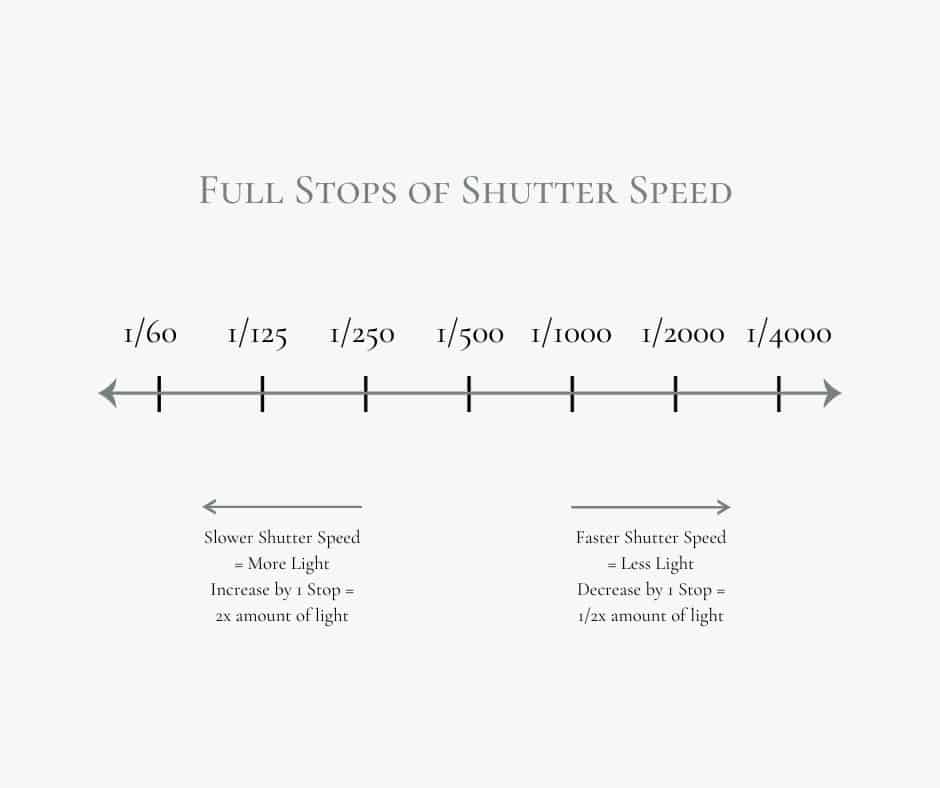
What to keep in mind when choosing the best shutter speed for portraits
If your goal is to choose a shutter speed that will create a sharp, in-focus portrait, there are a few guide posts to keep in mind. (I’m well aware that images with artistic motion blur are in vogue recently. If that’s the look you’re going for, try the opposite to what I’m suggesting for sharply focused portraits.)
1) For general portraits where your subject is mostly standing or sitting still, set your shutter speed to the inverse of 2x the lens focal length or faster.
Does this sound like calculus?
Sorry about that! I promise this is a simple concept. If you’re using a 50 mm lens, the focal length is “50mm”. Double that number (i.e. 50 x 2= 100). Then invert it (i.e. 1/100).
Therefore, with a 50 mm lens, avoid using a shutter speed slower than 1/100 if you are holding the camera by hand in order to avoid motion blur or loss of focus due to shutter speed.
Let’s walk through this example with a different lens. What if you love using a 85mm for portraits? The focus length is 85mm. Double that number (i.e. 85 x 2 = 170). Then invert it (i.e. 1/170). Okay, this one’s a little tricky. 1/170 is not a typical shutter speed stop. So for this lens I typically avoid using a shutter speed slower than 1/200 when hand holding my camera.
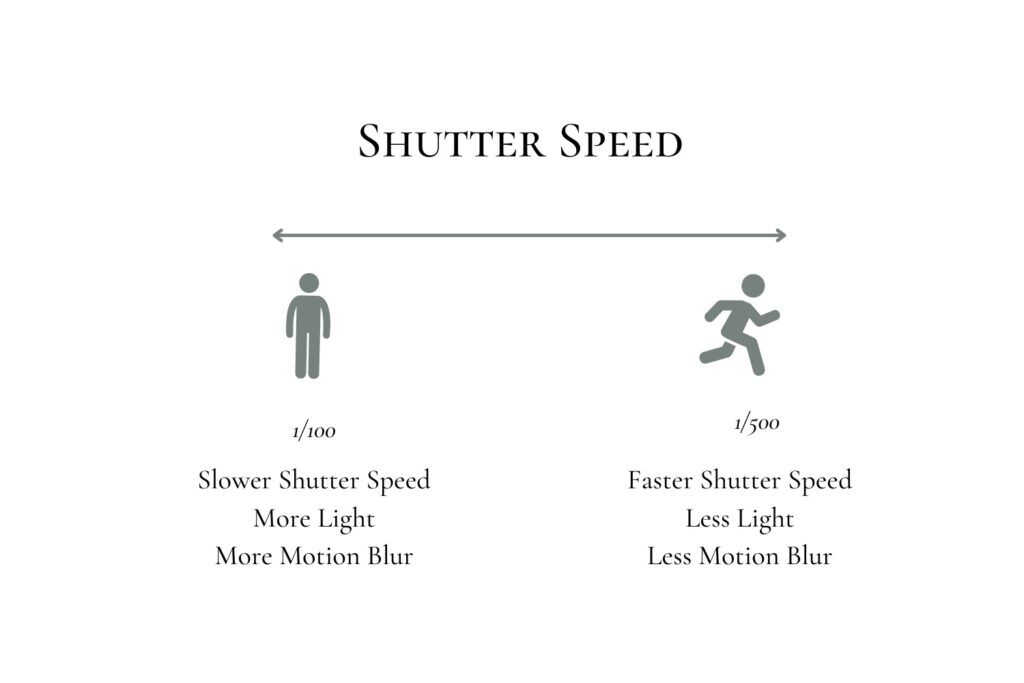
2) A shutter speed of 1/500 is generally a safe speed for freezing human movement.
Are you photographing young children or pets who rarely sit still for long and always seem to be in motion?
Same.
In those situations, a shutter speed of 1/500 is a safe starting place if you’re trying to capture a sharp image while your subject is in motion. When I’m planning to capture my subject walking, jumping, or running, I start with a shutter speed of 1/500 or faster and adjust my other settings to accommodate this faster speed.

How to balance shutter speed with your other settings?
When I’m dialing in settings to take a portrait, shutter speed is usually the second setting that I choose. I like to choose my aperture first because I feel like it has the greatest impact on the artistic quality of my photos. (I tend to shoot with fairly open apertures such as f2.0 or f2.8, which helps with letting in an adequate amount of light.)
After the aperture, I choose my shutter speed based on the amount of movement I anticipate. Lastly, I adjust my ISO until my in-camera light meter reads a balanced exposure using my Expodisc. However, I generally avoid going above ISO 800 for paid client work because I don’t like the increased digital noise that comes with higher ISO settings. If my aperture and shutter speed settings aren’t allowing me to use an ISO of 800 or less, then I’ll re-assess those first two settings and see if I can adjust one of them to let in more light.

What if there’s low light and you need a slower shutter speed?
If you need to use a slower shutter speed, outside of the parameters I’ve mentioned above, you can always consider using a tripod and remote. This can be a helpful adaptation if you have a tremor and struggle to hold the camera still. Most modern cameras have decent image stabilization features in the camera body and even lenses, but you may find using external stabilization helpful in avoiding motion blur at slower shutter speeds.
I personally prefer to use flash in low light situations. This allows me to continue using a shutter speed in a range that I’m comfortable with. Flash also helps freeze motion, which can help you get away with a slower shutter speed.

Best Shutter Speed for Portraits
Okay, so clearly the statement “best shutter speeds for portraits” is a little tricky. There is no one best shutter speed that you can plug in and use for every lighting scenario. If you talk to five different photographers you’ll likely receive five different answers. But here’s where I usually fall:
- For indoor sessions where I’m using off camera flash, I usually stick to a shutter speed around 1/200. (Read more about how shutter speed and flash interact here.)
- When shooting a family session or portrait during golden hour, I often use shutter speeds between 1/160-1/250 depending on whether I’m using my 85mm prime lens or my 28-75mm zoom lens.
- When prompting my subject to jump, walk, or run outside during golden hour, I set my shutter speed to 1/500 or higher.
- If shooting in the late morning or early evening in open shade, my shutter usually sits around 1/400-1/640.
- For photos taken in bright conditions like the beach after sunrise, I’m not afraid to use really fast shutters like 1/2500 or higher.

The moral of the story? If you’re missing focus a lot, take a look at your shutter speed and see if perhaps you’re using one that is too slow. Always keep in mind that you’ll have to adjust your aperture and ISO to compensate for any changes you’ve made in your shutter speed if you’d like to keep the same exposure.
Need a little more help with understanding exposure settings? Check out my Free Exposure Triangle Cheatsheet!
Read More:
